
News & Research
Can Loneliness Make You Drink More? Scientists Just Found a Clue in the Brain
A new study found that social isolation changed alcohol drinking in mice and identified a brain circuit that may help explain why. The human story is more complicated.

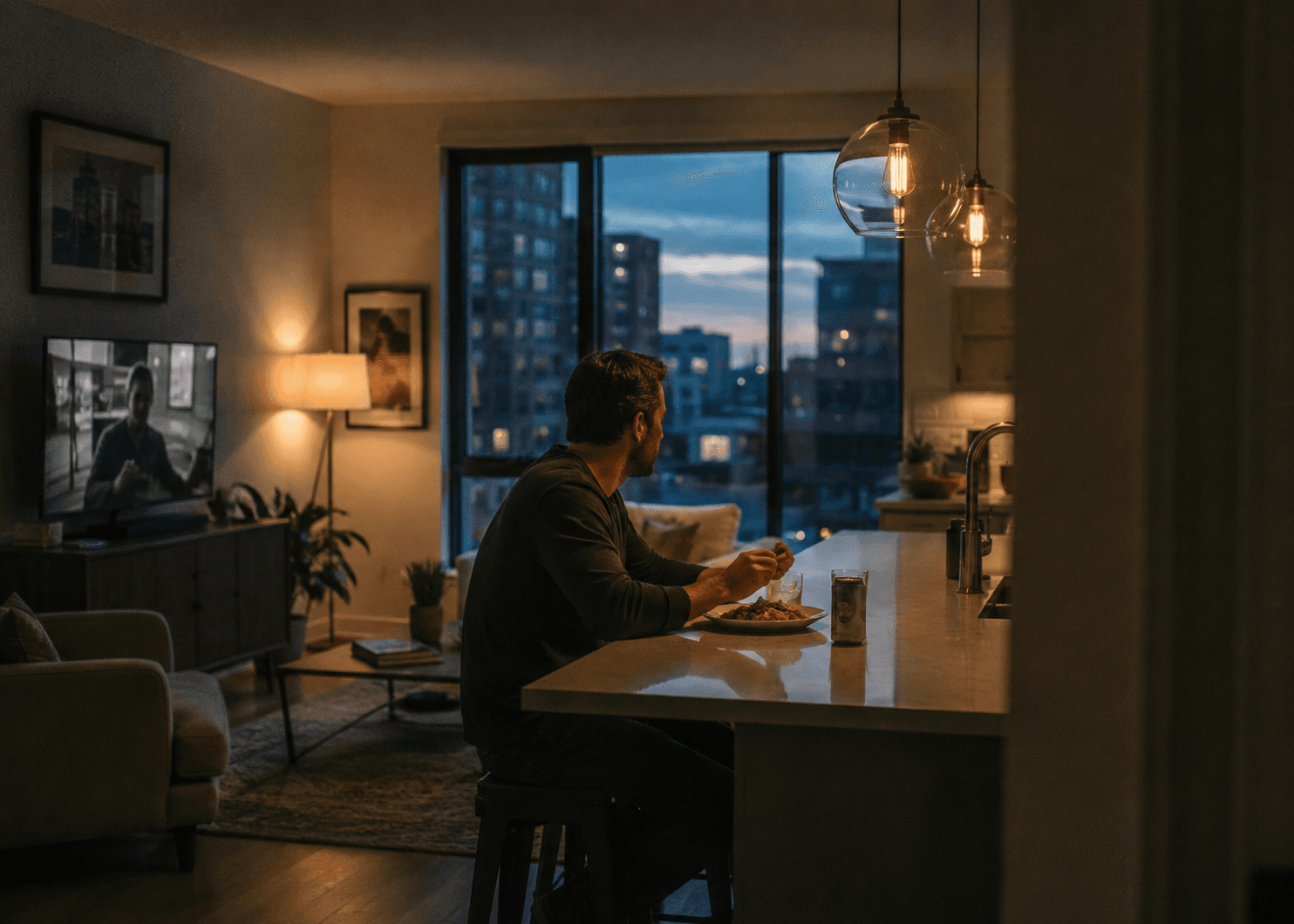
There is a familiar image of drinking alone.
A quiet house.
The end of a long day.
Nobody coming over.
Maybe dinner didn't really happen.
The television is on mostly because silence feels worse.
And somewhere along the way, pouring a drink becomes part of the evening.
We usually understand that behavior emotionally.
Someone is lonely, stressed, depressed or simply trying to make an empty night feel different.
But researchers have been asking a deeper question.
Can social isolation actually change the brain in ways that influence how appealing alcohol becomes?
A new study published August 25 in Nature Neuroscience offers an intriguing clue.
Researchers identified a pathway between two regions of the brain that influenced alcohol consumption after social isolation in mice.
And what happened wasn't nearly as simple as isolation makes you drink more.
In fact, male and female mice responded in opposite directions.
What the Researchers Actually Found
The experiment began with a relatively straightforward question.
Researchers compared alcohol and water consumption among male and female mice housed either socially or alone.
After 11 days of isolation, something striking happened.
Male mice drank more alcohol. Female mice drank less.
The same social condition produced opposite drinking responses depending on sex.
That alone would have been interesting.
But the researchers wanted to know why.
They focused on communication between two areas of the brain associated with emotion, stress, social processing and alcohol use: the basolateral amygdala and the medial prefrontal cortex.
They found neurons connecting those regions in both male and female mice.
What differed was how the circuit responded to isolation.
In males, isolation made the pathway more excitable.
In females, its excitability decreased.
That gave researchers something much more specific to investigate.
Not simply loneliness.
Not simply alcohol.
A biological pathway connecting social experience with drinking behavior.
Then They Changed the Circuit
This is where the experiment becomes particularly interesting.
Brain imaging showed that activity in this pathway could predict when the male mice would drink alcohol.
Researchers then artificially activated the pathway in mice that had not been socially isolated.
Alcohol consumption increased.
Then they did essentially the opposite.
When researchers inhibited the pathway in isolated male mice, alcohol drinking decreased.
In other words, the researchers didn't merely observe that isolation and alcohol consumption occurred together.
They were able to manipulate a specific neural circuit and change drinking behavior in their experimental model.
That is why this study is important.
But it is also where we need to be careful.
No, Scientists Did Not Find the “Loneliness Makes You Drink” Switch
This study was conducted in mice.
That sentence matters.
A lot.
Mice are enormously useful for understanding biological mechanisms that would be impossible or unethical to manipulate experimentally in humans.
But a mouse living alone for 11 days is not the same thing as a person going through divorce, grief, retirement, social anxiety or years of living alone.
Human loneliness is complicated.
Human drinking is complicated.
And human relationships with alcohol are influenced by genetics, environment, mental health, stress, culture, habit, trauma, availability and many individual circumstances.
The National Institute on Alcohol Abuse and Alcoholism describes alcohol use disorder as the result of a complex interplay of biological and environmental factors rather than one single cause.
So this study does not prove that loneliness causes people to drink.
It does not mean a socially isolated man will develop an alcohol problem.
And it certainly does not mean women are somehow protected from drinking when they're lonely.
What it does show is that, in this animal model, social isolation altered neural activity in a way that changed alcohol consumption.
That is a much narrower conclusion.
It's also a fascinating one.
The Male and Female Difference Might Be the Biggest Surprise
The researchers themselves emphasize this part.
Social isolation didn't simply produce a weaker version of the same response in female mice.
It produced the opposite drinking response.
Male mice drank more.
Female mice drank less.
And the brain circuit changed in opposite directions too.
That matters because biological sex has not always been treated as a sufficiently important variable in biomedical research.
The researchers argue that these findings reinforce the importance of studying male and female biology when investigating alcohol use disorder and potential future treatments.
It also gives us another reason not to reduce alcohol problems to simple explanations.
Two individuals can experience the same stressful event and respond completely differently.
One drinks more.
Another drinks less.
Someone else doesn't change at all.
The behavior we can see may be the end result of many different processes underneath it.
Isolation and Loneliness Aren't Exactly the Same Thing
There's another distinction worth making.
Social isolation generally describes something more objective: having relatively little social contact or interaction.
Loneliness describes the subjective feeling that the connection you want is missing.
You can live alone and not feel lonely.
You can be surrounded by people and feel profoundly alone.
You can spend an entire weekend by yourself and love every minute of it.
Or you can sit at a crowded dinner table and feel like nobody there actually knows you.
That's why the headline question, can loneliness make you drink more, is useful for humans, but the new experiment itself is specifically about social isolation in mice.
Those aren't interchangeable.
Still, the distinction makes the human question more interesting.
Because sometimes the risk isn't simply being physically alone.
It's becoming increasingly disconnected.

Drinking Can Become Part of the Isolation
It's tempting to imagine this relationship moving in one direction.
Isolation → drinking
But human life rarely works that neatly.
Alcohol can become part of the reason someone withdraws too.
- Maybe going out feels like too much work.
- Maybe drinking at home is easier.
- Maybe sleep gets worse.
- Maybe mornings get harder.
- Maybe plans start getting canceled.
- Maybe embarrassment makes someone avoid people.
- Maybe relationships become strained.
Then the person spends more time alone.
And being alone creates more opportunity to drink.
The cycle can begin feeding itself.
That doesn't mean every person who drinks alone has a problem.
Plenty of adults have a drink at home without anything remotely resembling alcohol use disorder.
The more useful question is whether the pattern is changing.
Is alcohol becoming more important as everything else becomes less present?

When Nobody Else Sees the Progression
There is another part of social isolation that neuroscience can't fully capture.
Visibility.
People who share their daily life with others are sometimes observed in ways they barely notice.
- Someone sees that you haven't eaten.
- Someone notices you've stopped going outside.
- Someone asks why you're awake at 3 a.m.
- Someone notices you've called in sick again.
- Someone sees the recycling.
- Someone notices that the house doesn't look like it normally does.
Someone simply says:
Are you okay?
Living alone does not mean something is wrong.
Millions of people live alone and thrive.
And living with other people certainly doesn't guarantee that a drinking problem will be noticed.
But severe isolation can remove some of those ordinary opportunities for another person to notice that something has changed.
A problem can become worse behind a closed door precisely because fewer people are seeing the progression.
That's one reason connection can matter even when someone genuinely enjoys living alone.
The Warning Signs May Look Ordinary at First
Not every concerning drinking pattern begins dramatically.
Sometimes it's remarkably boring.
One drink while making dinner.
Then two.
Then drinking becomes the signal that work is finished.
Then it becomes something you look forward to.
Then something you expect.
Maybe dinner becomes less important.
Maybe plans feel increasingly inconvenient.
Maybe you realize you haven't had an alcohol-free evening in a while.
None of those things individually diagnoses alcohol use disorder.
But patterns matter.
And sometimes the most important moment isn't when something becomes catastrophic.
It's when you notice: this is becoming different.
Continue reading
Social changes can work in both directions. I also wrote about what happens when stopping drinking changes the friendships around you.
Connection Doesn't Have to Mean Becoming Social
When people hear advice about loneliness, the solution can sound exhausting.
- Join a club.
- Make new friends.
- Go to events.
- Put yourself out there.
That may be great advice for some people.
For someone already overwhelmed, it can sound impossible.
Connection can be much smaller.
- Answer the text.
- Call your brother.
- Walk the dog with someone.
- Sit in a coffee shop instead of staying home all day.
- Have dinner with one person.
- Go somewhere you already feel comfortable.
- Tell somebody you've been having a rough week.
NIAAA's Rethinking Drinking guidance similarly emphasizes asking others for support, developing rewarding activities that don't involve alcohol, and building new interests and social groups when someone is changing their drinking.
The goal isn't to become the most social person in the room.
It's to make sure your world still contains other people.

Why This Research Matters
The immediate importance of this study isn't that scientists discovered a treatment for loneliness or alcohol use disorder.
They didn't.
It's that researchers identified one possible biological mechanism through which an adverse social experience can influence alcohol consumption.
That gives scientists something specific to investigate.
- Could similar circuitry help explain vulnerability in humans?
- Could differences in that circuitry help identify who is more susceptible to isolation-related drinking?
- Could sex differences eventually influence how prevention or treatment works?
Those questions remain open.
The researchers describe the work as a possible foundation for better risk prediction and treatment strategies, not an answer ready for the clinic today.
That's how early science is supposed to work.
One carefully defined answer creates better questions.
Maybe the Important Question Is Smaller
Most of us will never know what's happening between our basolateral amygdala and medial prefrontal cortex tonight.
We probably don't need to.
There is a much simpler question we can actually answer.
How connected have I been lately?
Not how many followers you have.
Not how many people liked something you posted.
Not how many names are in your contacts.
When was the last time you actually talked to someone?
When was the last time somebody knew how you were doing?
When was the last time you left the house for something that wasn't an obligation?
And if alcohol has quietly become the most reliable part of your evening, when did that start?
Those questions don't diagnose anything.
They just make something visible.
And sometimes visibility is where change begins.
Frequently Asked Questions
Can loneliness make you drink more alcohol?
Human behavior is too complex to say that loneliness simply causes increased drinking. The new Nature Neuroscience study found that social isolation increased alcohol consumption in male mice while decreasing it in female mice. Human research is needed to determine how the identified neural mechanisms might translate to people.
What did the new social isolation and alcohol study find?
Researchers identified a neural pathway connecting the basolateral amygdala and medial prefrontal cortex that influenced isolation-related alcohol drinking in mice. Isolation increased the pathway's excitability and alcohol consumption in males, while females showed the opposite pattern. Manipulating the pathway also changed drinking behavior in male mice.
Is loneliness the same as social isolation?
No. Social isolation generally refers to limited social contact or interaction, while loneliness is the subjective feeling that someone lacks the connection they want. A person can live alone without feeling lonely, or feel lonely while surrounded by other people.
Does living alone increase the risk of alcoholism?
Living alone by itself does not mean someone will develop alcohol use disorder. Alcohol use disorder has many potential influences, including genetics, drinking patterns, mental health, stress, trauma, environment and other individual factors. The new study investigated experimentally induced social isolation in mice, not people living alone.
Why do some people drink when they're lonely?
People may use alcohol for many reasons, including stress relief, habit, boredom, coping or temporary emotional relief. The new animal research suggests social isolation can influence neural pathways involved in alcohol consumption, but more research is needed before those mechanisms can be applied directly to human loneliness or drinking behavior.
Can drinking make loneliness worse?
For some people, drinking and isolation can become a bidirectional pattern. Drinking may contribute to canceled plans, poorer routines, relationship strain or withdrawal from activities, while increasing isolation can create more opportunities or motivation to drink. That does not happen to everyone, but changes in both drinking and social connection are worth noticing.
How can I feel less isolated while changing my drinking?
Connection does not have to mean building an entirely new social life. Small steps such as answering a message, calling someone you trust, meeting one person for coffee, joining an activity you already enjoy, or asking friends and family for specific support can help make your world feel less closed off.