
Research & Wellness
Your Alcohol Craving Might Not Be as Random as It Feels
A craving can feel like it came from nowhere. New real-world research suggests the moments before it may contain more clues than we realize.

A craving can feel like it came from nowhere.
You were fine five minutes ago. You weren't thinking about drinking. Maybe you weren't even having a bad day.
Then somebody opens a bottle. You walk into a familiar restaurant. A friend sends a text. The game comes on. It's 5:30. The weather is perfect.
And suddenly: I want a drink.
It can feel completely spontaneous.
But researchers studying alcohol use in everyday life are increasingly asking a different question: what happened right before you noticed the craving?
The craving may be the first thing you consciously noticed. That doesn't necessarily mean it was the first thing happening.
A craving can feel spontaneous because you notice the craving before you notice everything that created it.
The Problem With Studying Drinking in a Laboratory
Laboratories are useful. Researchers can control the environment, isolate variables and measure things that are difficult to measure in ordinary life.
But your life doesn't look like a laboratory.
Cravings happen in kitchens, restaurants, backyards, hotel rooms, football parties, grocery stores and on the drive home from work.
Sometimes you're stressed. Sometimes you're celebrating. Sometimes absolutely nothing interesting seems to be happening.
So researchers increasingly bring part of the laboratory with you. It's probably already in your pocket.
Your Phone Can Catch a Moment Your Memory Might Miss
The method is called ecological momentary assessment, usually shortened to EMA.
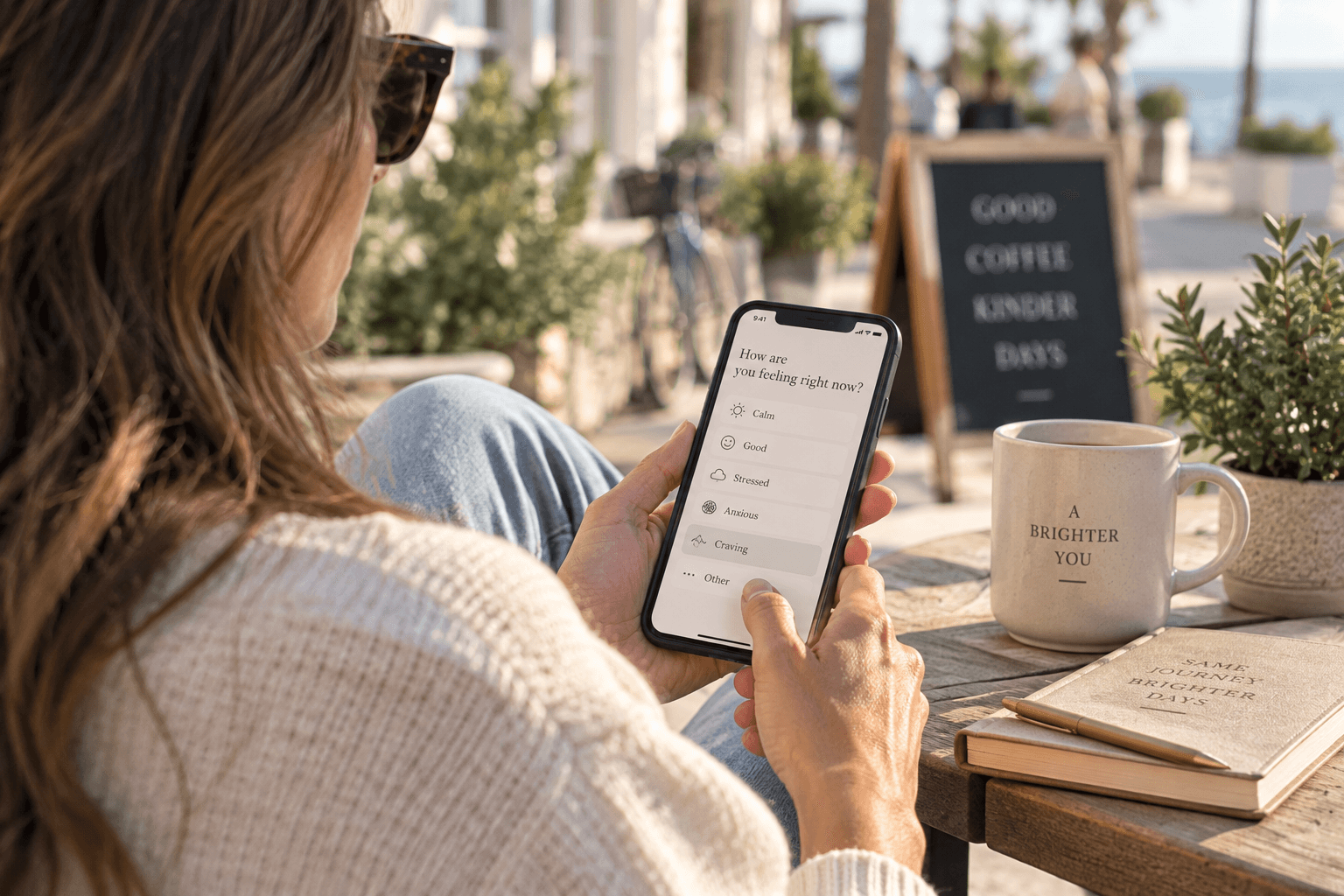
Instead of asking someone weeks later what usually makes them want alcohol, researchers can ask questions repeatedly while that person is actually going through everyday life.
- Where are you?
- Who are you with?
- How are you feeling?
- Are you around alcohol?
- Are you drinking?
- How strong is your craving right now?
Modern EMA research often uses participants' own smartphones, allowing researchers to collect information close to when experiences actually happen.
A narrative review published September 11 in Current Addiction Reports examined how event-contingent EMA and newer mobile technologies are being used to study drinking episodes in natural environments.
Memory asks what usually happens. EMA asks what is happening right now.
Researchers Are Getting Closer to the Drinking Episode Itself
Event-contingent EMA can tie assessments to drinking events rather than only sending surveys at arbitrary times.
Researchers can study craving, subjective intoxication, drinking context, drinking speed and how an episode changes as it unfolds.
The goal isn't merely to count drinks more accurately. It's to understand the sequence.
Two people can both report having four drinks Saturday while having completely different experiences. The number can be the same while the pattern is completely different.
A New Study Looked Directly at Craving in Real Life
A separate study published online this month gives us a useful example of what this kind of research can reveal.
Thirty-three adults with alcohol use disorder completed smartphone assessments up to four times a day for 28 days.
Researchers measured craving, direct exposure to alcohol, being around usual drinking partners, being in usual drinking places, and positive and negative emotional states.
This was a small and specific sample of adults with alcohol use disorder who were participating in an intervention study.
The findings should not be treated as universal rules for everyone who drinks, is sober-curious or experiences an occasional craving.
Seeing Alcohol Mattered
When participants had greater-than-usual direct exposure to alcohol, craving tended to be higher.
That probably doesn't sound shocking. But alcohol cues appear constantly without us consciously labeling them as triggers.
- The bottle behind the restaurant bar.
- Beer being opened at a party.
- Wine being poured at dinner.
- A refrigerator stocked for guests.
- Someone carrying the drink you used to order.
Your brain doesn't require you to narrate the experience for the cue to exist.
The People Around You Mattered Too
Participants also tended to report greater craving when they were around their usual drinking partners.
A trigger isn't necessarily an object. It can be a person, without that person doing anything wrong.
If two people spent years drinking together, the person can become part of a learned context: friend, Friday, bar, beer.
Sometimes the trigger isn't what's in front of you. It's what usually happened next.
The Surprising Trigger: Feeling Good
We tend to talk about cravings as if they're almost always responses to something unpleasant.
Stress, anxiety, loneliness and a terrible day can matter. But humans also drink when life feels fantastic.
Vacation starts. Your team wins. Friends arrive. The sun is out. Music is playing. You got the promotion. It's Friday.
In this study, direct alcohol exposure was more strongly associated with craving during moments when participants reported higher-than-usual positive affect.
That does not mean happiness causes alcohol cravings.
It means that, in this sample, the relationship between seeing alcohol and craving became stronger when positive emotion was elevated.
Sometimes nothing is wrong. The brain may simply have learned: this is when we celebrate.

Negative Feelings Had a Different Relationship With Place
Being in a usual drinking location by itself was not independently associated with greater craving after adjustment.
But when participants were experiencing higher-than-usual negative affect, being in their usual drinking places was associated with stronger craving.
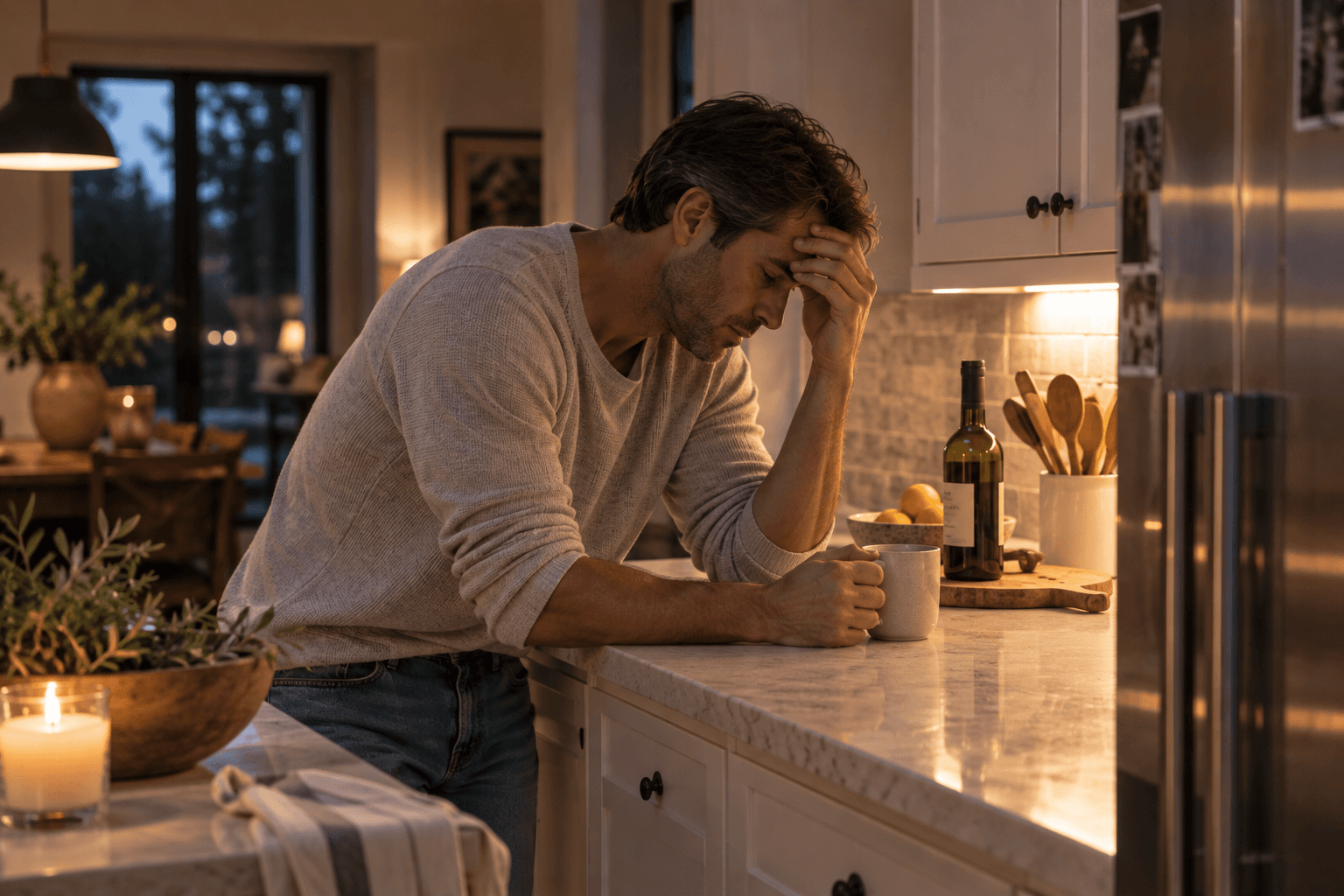
Now imagine the combination: bad day, drive home, same kitchen, same refrigerator, same counter, same time of evening.
For years, maybe the next step was pouring a drink.
The location alone may not be the whole story. The bad mood alone may not be the whole story. The combination may matter.
Your Brain Learns Combinations
This may be a more useful way to think about triggers.
Sometimes the pattern isn't simply wine, stress or Friday.
Sometimes it is Friday + 5 p.m. + kitchen + cooking + music.
Or friend + restaurant + good mood + wine list.
Or bad day + home alone + same chair + 6 p.m.
Individual pieces can be harmless. Put them together and your brain recognizes a familiar sequence.
Why 5 p.m. Can Start Feeling Like a Trigger
You finish work. You walk into the kitchen. You pour wine. You start dinner.
Do that often enough and those events stop feeling unrelated.
Eventually the clock itself can feel like it knows what's supposed to happen.
Of course, the clock doesn't know anything. But your brain is exceptionally good at learning patterns.
A craving isn't always asking for alcohol. Sometimes it's reacting to a sequence that didn't finish the way it expected.
Tracking Isn't About Watching Yourself All Day
The point isn't to document every thought about alcohol. It's to capture enough information that repetition becomes visible.
Maybe you record ten cravings. Seven happen between 4:30 and 6:30. Five happen while you're cooking. Four involve the same person. Six happen on Fridays and Saturdays.
Suddenly, my cravings are random becomes: huh, that's interesting.
That's useful because you've made something invisible a little more visible.
Memory tells stories. Patterns leave evidence.
Patterns Aren't Predictions
If you notice that Friday evenings are difficult, it doesn't mean you will crave alcohol every Friday.
Patterns describe what has happened. They don't guarantee what will happen.
The goal isn't to build a perfect prediction machine. It's to become a little less surprised by yourself.
What Do You Do Once You Notice a Pattern?
You experiment, not with your whole life, but with one piece.
- If cooking dinner is repeatedly difficult, change what you're drinking while you cook.
- If Friday at 5 is hard, don't wait until 5:05 to invent a plan.
- If a certain restaurant makes you uncomfortable, choose somewhere else for a while.
- If a particular friend is strongly associated with drinking, try seeing them somewhere new.
- If celebrations trigger you, decide what you're ordering before you arrive.
You're not proving anything scientifically. You're simply asking: what happens if I change this part?
The Pattern Can Change
Learned associations are learned. New associations can be learned too.
Friday at 5 doesn't inherently belong to alcohol. Neither does football, cooking, vacation, a particular restaurant or celebration.
For a while, those things may feel connected because they were connected.
Then you start giving the brain new repetitions.
Continue reading
If seeing a drink can suddenly create a craving, our recent founder article looks more closely at why alcohol cues can feel so immediate.
What This Research Cannot Tell Us
The craving study involved only 33 adults with alcohol use disorder who were participating in an intervention study.
It does not prove that every sober person, moderate drinker or sober-curious person responds to cues the same way.
EMA studies also rely substantially on self-report, and repeated prompting can create reporting burden or missing data.
The September 11 paper is a narrative review, not a randomized clinical trial showing that smartphone monitoring improves sobriety outcomes.
The takeaway is not that your phone can predict when you'll drink.
Maybe It Didn't Come Out of Nowhere
The craving appeared. And maybe you noticed it immediately.
What you didn't notice immediately was everything around it.
Maybe the music was familiar. The time was familiar. The room was familiar. The people were familiar. The feeling was familiar.
Maybe somebody opened a bottle. Maybe you'd had a terrible day. Maybe you'd had an incredible one.
Maybe several completely ordinary things lined up in exactly the combination your brain had learned over years.
Your brain simply got there before you did.
Once you start noticing what tends to happen right before the craving, random can slowly become recognizable.
Frequently Asked Questions
What can trigger an alcohol craving?
Alcohol cues, people you usually drank with, familiar routines, emotions, time of day and combinations of these factors can all be relevant. Triggers vary substantially from person to person.
Can a good mood trigger an alcohol craving?
It can be part of the context. In a small study of adults with alcohol use disorder, direct alcohol exposure was more strongly associated with craving during moments of higher-than-usual positive affect. That does not mean happiness itself causes craving.
Can a familiar place trigger a craving?
Possibly, but context matters. In the new study, usual drinking places were not independently associated with greater craving overall. They were associated with stronger craving during moments of higher-than-usual negative affect.
What is ecological momentary assessment?
Ecological momentary assessment, or EMA, collects repeated reports about behavior and experience in real-world settings, often through a smartphone. It helps researchers study what is happening close to the moment rather than relying only on later recall.
Does tracking cravings help identify patterns?
Personal tracking can help make repeated contexts easier to notice, such as certain times, situations or routines. It cannot prove what caused a craving or predict every future craving.
Are alcohol cravings always caused by stress?
No. Stress and negative emotion can be relevant, but alcohol can also become associated with positive experiences such as celebration, social connection, weekends and other rewarding situations.