

Sobriety & Life
I Don't Even Enjoy Drinking Anymore. So Why Do I Still Want It?
There was a point when I realized I wasn't having that much fun drinking anymore. The strange part was that I still wanted the first drink.

There was a point near the end of my drinking when I realized something that should have made quitting incredibly easy.
I wasn't having that much fun anymore.
The first drink still sounded good.
That's the weird part.
Five o'clock would come around and I'd want it.
Friday night?
Obviously.
Dinner out?
Definitely.
Nice weather?
That deserved a drink.
Vacation?
Don't even ask.
There were a hundred situations where my brain seemed to know exactly what was supposed to happen next.
Then I'd have the drink.
And eventually I'd think:
This isn't even that great.
Maybe the first one was good.
Maybe the first twenty minutes were good.
But somewhere along the way, wanting to drink and actually enjoying drinking had become two very different things.
And yet the next day, right on schedule:
Want one?
That never made much sense to me.
If I didn't enjoy where drinking was taking me anymore, why did I keep wanting to go?
Apparently, Wanting and Liking Aren't the Same Thing
This is one of those times when science puts language around something you've experienced for years.
A new study published in Scientific Reports looked at alcohol wanting and liking among 446 adults.
Researchers were interested in whether those two experiences related differently to why people drink.
And they did.
Self-reported wanting was more strongly associated with drinking motivations than liking was.
The relationship was particularly pronounced for internal drinking motivations.
That's interesting because it suggests something most people who've changed their drinking probably already understand intuitively:
Wanting a drink doesn't necessarily mean you're expecting to love the drink.
The researchers are careful here, and we should be too.
This was an exploratory, cross-sectional study.
It can't tell us that one thing caused another.
It doesn't prove that everyone's drinking eventually separates into wanting and liking.
And it definitely doesn't mean scientists have discovered the one explanation for why people keep drinking when drinking isn't making them particularly happy.
Human beings are never that convenient.
But it gives us a useful distinction.
Wanting.
Liking.
Maybe they're not always the same question.
I Think I Wanted the Moment More Than the Drink
When I look back at my own drinking, this makes more sense than I'd like to admit.
Five o'clock wasn't just a time.
It meant:
Work is over.
Friday meant:
The week is over.
Dinner out meant:
Tonight is different.
Vacation meant:
We're officially having fun now.
Warm weather. A patio. Football. Cooking dinner. A hotel balcony. A good restaurant. A bad day. A great day.
Alcohol had somehow managed to get itself hired for all of them.
That's impressive when you think about it.
One product had become appropriate for celebrating, relaxing, socializing, recovering, rewarding, vacationing, cooking, eating and doing absolutely nothing.
Maybe sometimes what I wanted wasn't the alcohol itself.
Maybe I wanted the transition.
The signal.
The familiar moment when one part of the day ended and another began.
Alcohol just happened to be what I'd taught myself belonged there.

Your Brain Doesn't Take a Yelp Review After Every Drink
Logically, you'd think this would be easy.
Drink Friday.
Sleep terribly.
Wake up tired.
Remember that the last two drinks weren't even enjoyable.
Two stars. Would not recommend.
Saturday afternoon arrives.
Problem solved.
Except that's not really how habits seem to work.
The disappointing experience doesn't necessarily erase everything that came before it.
Years of Friday equals drink don't disappear because last Friday wasn't particularly good.
Neither does restaurant equals drink, vacation equals drink or stress equals drink.
A familiar cue can still produce a familiar suggestion.
And recent real-world craving research gives us another interesting piece of that puzzle.
A September study followed 33 adults with alcohol use disorder for 28 days using assessments delivered throughout everyday life.
When participants encountered alcohol itself more than usual, craving was higher.
Being around their usual drinking partners was independently associated with higher craving too.
And context interacted with mood in interesting ways.
Alcohol exposure was associated with stronger craving when people were experiencing higher-than-usual positive affect.
Feeling good doesn't necessarily protect you from wanting alcohol.
Sometimes feeling good while alcohol is right there can make the pull stronger.
That's important because we talk so much about drinking when we're miserable.
Stress.
Anxiety.
Bad day.
Loneliness.
Those absolutely matter.
But sometimes you want a drink because the weather is beautiful and everybody you love is sitting around a table.
Nothing is wrong.
The moment itself is the cue.
Maybe That's Why Cravings Can Feel So Irrational
You're having a perfectly good day.
You don't need relief.
You're not falling apart.
You're not trying to escape anything.
Then you see the patio.
Or somebody opens a bottle.
Or the grill starts.
Or your friend orders one.
And there it is.
I want a drink.
That's where I think people can become unnecessarily hard on themselves.
Because the thought feels like evidence.
If I want alcohol, maybe I secretly still want to drink.
Maybe I'm not really done.
Maybe sobriety isn't working.
Maybe part of me wants my old life back.
That's a lot of meaning to assign to one thought.
What if it's simpler?
Sometimes an old system is just making an old suggestion.
You don't have to hold a committee meeting every time it happens.
Wanting Something Doesn't Mean You Want Everything That Comes With It
This distinction would have helped me earlier.
Because when I wanted a drink, I thought the choice was:
drink
or
deny myself something I want.
But that wasn't really the whole choice.
I could want:
- The first sip.
- The glass.
- The ritual.
- The twenty minutes of relaxation.
- The transition out of work.
- The feeling that Friday had officially started.
Without wanting:
- The fourth drink.
- The bad sleep.
- The anxiety.
- The next morning.
- The time I lost.
- The larger drinking pattern that came with it.
Those things can all be true at once.
You can miss one piece of something without wanting the entire thing back.
That's not hypocrisy.
That's being a person.
The First Drink Was Doing a Lot of Marketing for the Rest of the Night
This is another thing I understand differently now.
When I remembered drinking, I wasn't always remembering the whole night equally.
I remembered the beginning.
The pour.
The first sip.
Music on.
Dinner cooking.
Sitting outside.
That first feeling of:
Okay. The day is over.
That's an excellent advertisement.
The 2 a.m. sleep?
Less glamorous.
The next morning?
Terrible marketing department.
The fourth drink I didn't particularly need?
Nobody put that one in the brochure.
So when the thought of drinking showed up, it wasn't necessarily presenting an honest documentary of the entire experience.
It was showing me the trailer.
And the trailer had been edited very well.
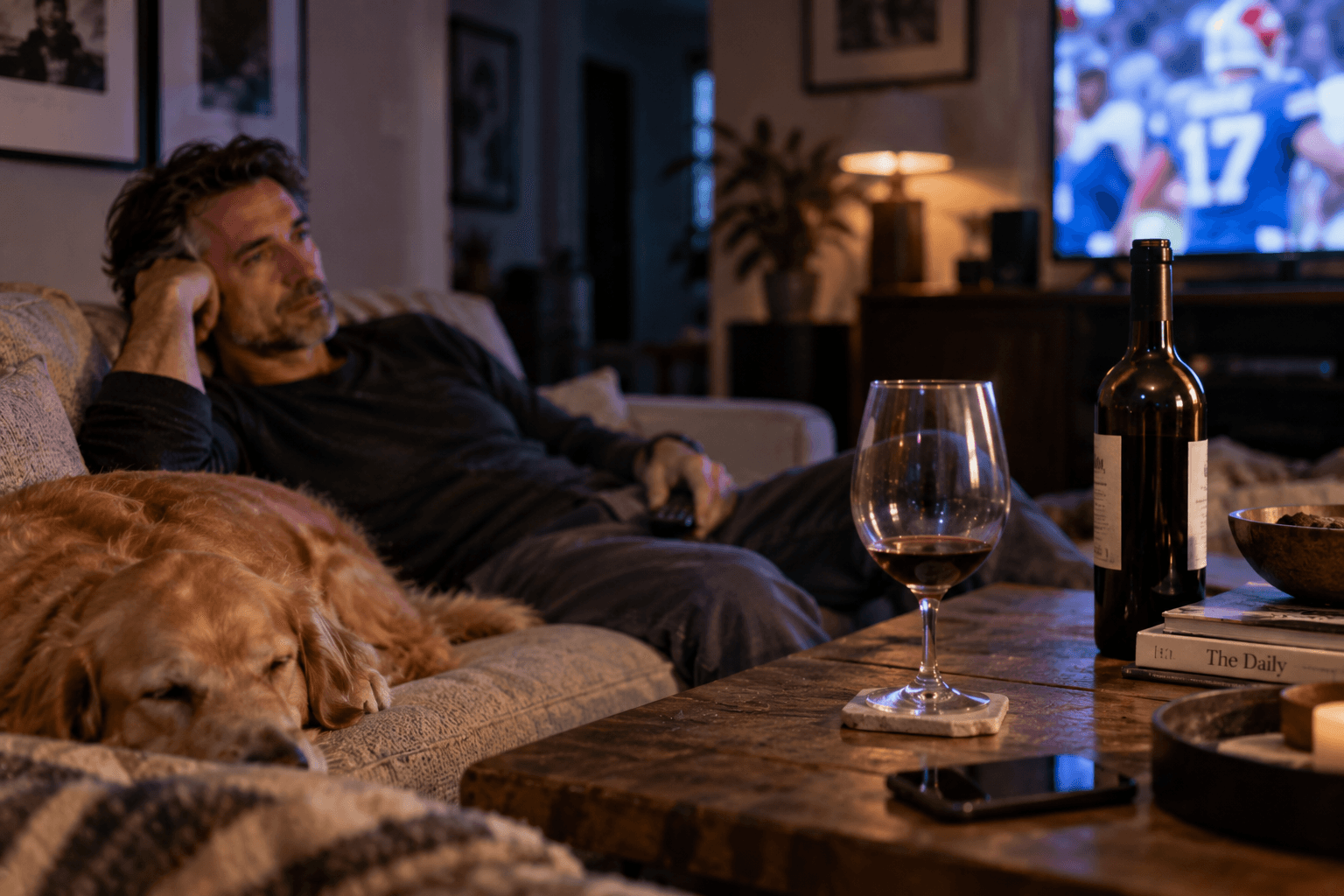
Stop Asking Why Do I Want This Like It's a Character Flaw
There's another way to ask the question.
Instead of:
What the hell is wrong with me?
Try:
What exactly do I want right now?
Relief?
A transition?
Something cold?
A reward?
To stop thinking?
To belong?
To make dinner feel different?
To change how I feel?
To celebrate?
To mark the end of the week?
Those aren't the same needs.
And alcohol isn't the only possible answer to all of them.
The useful question may not be why do I want alcohol? It may be what job am I asking alcohol to do right now?
That question gives you somewhere to go.
Sometimes the Answer Really Is I Want to Get Drunk
We should say this too.
Not every craving is secretly asking for sparkling water and a relaxing walk.
Sometimes somebody wants alcohol because they want alcohol.
They want the buzz.
They want intoxication.
They want their brain to shut up for a while.
They want to feel different.
Pretending otherwise doesn't help anybody.
And this is where the wanting-versus-liking distinction becomes even more interesting.
You can want the effect while knowing perfectly well you won't like everything that follows it.
People make choices like that all the time.
The goal isn't to trick yourself into believing you never liked alcohol.
I did.
Sometimes a lot.
The goal is being able to hold the entire truth at once.
I want this right now. And I know where this usually goes.
Both can be true.
An Urge Isn't a Decision
This may have been one of the biggest shifts for me.
At some point, wanting a drink stopped automatically requiring a response.
The thought could show up.
Drink?
And I didn't have to panic.
I didn't have to argue with myself for an hour.
I didn't have to prove that I hated alcohol.
And I didn't have to obey it.
It could just be there.
That's surprisingly freeing.
Because if every craving becomes an emergency, you're still letting alcohol control the evening.
You're just fighting with it instead of drinking it.
Sometimes the thought can simply be: I would like a drink.
Okay.
What else is happening?
Pay Attention to the Scene Around the Wanting
This is where patterns become useful.
Don't only record: I wanted alcohol.
Look at the scene.
- What time was it?
- Who were you with?
- What were you doing?
- Was alcohol physically there?
- Were you having a bad day?
- Were you having an unusually good day?
- Had you eaten?
- Was it Friday?
- Were you cooking?
- Did somebody else pour one?
- Were you at the restaurant where you've ordered the same drink fifty times?
The small September real-world study I mentioned earlier is useful precisely because craving changed with context.
Direct exposure to alcohol and being around usual drinking partners were each associated with higher momentary craving among the adults with alcohol use disorder who participated.
Thirty-three people is a small sample.
It doesn't tell us exactly what causes your craving.
But it reinforces a useful idea:
Craving happens somewhere.
Pay attention to where.
Continue reading
If the quiet spaces feel strange after alcohol is gone, I wrote about why ordinary life can feel unexpectedly flat at first and how those routines slowly start becoming yours again.
You Don't Have to Ruin the Moment to Change the Drink
This took me a while.
I think part of me believed that not drinking meant admitting all those drinking situations were fake.
The patio wasn't fun.
Vacation wasn't fun.
Dinner wasn't fun.
Friday wasn't fun.
But that's ridiculous.
Of course they were fun.
The people were real.
The sunset was real.
The restaurant was good.
The trip was great.
The music was great.
The conversation was real.
Alcohol didn't invent any of those things.
It was just standing nearby taking an unreasonable amount of credit.
That's an important distinction.
Because once I stopped giving alcohol ownership of the entire moment, I didn't have to replace my whole life.
I just had to learn what the moment felt like without it.
At First, the New Version Can Feel Slightly Wrong
Of course it can.
You've done the old version hundreds of times.
Friday plus drink.
Dinner plus drink.
Vacation plus drink.
Then suddenly:
Friday.
Dinner.
Vacation.
And nothing follows.
Your brain notices the missing piece.
That doesn't necessarily mean the new version is worse.
It may simply mean it's new.
Eventually you collect another set of repetitions.
- Friday without it.
- Dinner without it.
- Vacation without it.
- Good weather without it.
- Bad day without it.
- Great day without it.
And those start becoming familiar too.
Maybe that's part of how wanting eventually loses some of its authority.
Not because the thought never appears. Because you've stopped treating it like instructions.
The Weird Part Is That Life Eventually Gets Bigger Again
When alcohol was attached to everything, it felt like removing it would make everything smaller.
Less fun.
Less spontaneous.
Less social.
Less relaxing.
Instead, over time, alcohol became smaller.
Not life.
That's the part I never would have believed when I was still drinking.
I thought alcohol was adding something to all these moments.
Eventually I started noticing how often I was organizing the moments around alcohol.
- Where we'd go.
- When we'd leave.
- Whether I'd drive.
- What we'd order.
- Whether there was enough.
- How late we'd stay.
- What tomorrow would feel like.
That's a lot of administrative work for something I supposedly needed to relax.

I Don't Need to Pretend I Never Want It
Four years later, I don't think the goal is becoming a person who looks at alcohol and feels absolutely nothing forever.
Maybe some people get there.
Great.
I don't need that test.
A beautiful restaurant can still look beautiful.
A cold drink on a patio can still look good.
Friday can still feel like Friday.
And my brain is allowed to remember things it did for years.
The difference is that wanting something doesn't automatically make it important.
It doesn't automatically make it a good idea.
And it definitely doesn't make it a command.
Eventually I stopped interpreting I want a drink as proof that I should have one.
That was probably a bigger change than I realized at the time.
The weather could be perfect.
Dinner could be starting.
Friday could still feel like Friday.
And my brain could make the same suggestion it had made hundreds of times before.
Drink?
I didn't need to panic about it.
I didn't need to debate it for an hour.
And I definitely didn't need to pretend I suddenly hated alcohol.
I could just know something the craving didn't know yet.
I've tried that already. I know how tonight goes. And I like tomorrow better.
That's enough.
Frequently Asked Questions
Why do I still want alcohol if I don't enjoy drinking anymore?
Wanting alcohol and enjoying alcohol are not necessarily the same experience. A 2026 study of 446 adults found that self-reported alcohol wanting was more strongly associated with drinking motivations than liking was. Familiar cues, routines, expectations and the effects someone associates with alcohol may all contribute to wanting a drink even when the overall drinking experience has become less enjoyable.
Can you crave alcohol even when you don't actually want to drink?
Yes. An urge or craving does not automatically mean you have decided to drink or that you want everything that comes with drinking. Cravings can occur around familiar alcohol cues, people, places and routines. Noticing the context around the craving can help you understand what may be contributing to it.
Why do I want alcohol when I'm having a good day?
Cravings are not limited to stress or negative emotions. A small 2026 real-world study of adults with alcohol use disorder found that alcohol exposure was associated with stronger craving during periods of higher-than-usual positive affect. Celebrations, good weather, restaurants, friends and other familiar positive situations can also become associated with drinking.
Why do certain places or people make me want to drink?
Repeated drinking can create strong associations with particular people, places and routines. In a 28-day study of 33 adults with alcohol use disorder, direct alcohol exposure and being around usual drinking partners were independently associated with higher momentary craving. That does not mean every craving has the same cause, but context can matter.
What can I do when I suddenly want a drink?
Instead of treating the urge as a command, notice what is happening around it. Ask what time it is, where you are, who you are with, what you are feeling and what you hoped the drink would do for you. If cravings feel difficult to manage, happen frequently or put your recovery at risk, additional support from a healthcare professional or recovery resource may help.